Jinan Huanqiu Glass Technology Co., Ltd.

Vacuum Glass

Why Choose Us
 

Company Strength
Jinan Huanqiu Glass Technology Co., Ltd. is a large-scale glass building materials enterprise specializing in the production and processing of various types of tempered glass, insulating glass, laminated glass, coated glass, architectural engineering glass, and high-end system door and window glass.


General Project
We Business scope includes general projects: glass manufacturing, hollow glass, laminated glass, special-shaped glass, metal door and window engineering construction: door and window sales: building materials sales; building decoration materials sales; hardware product wholesale; hardware product retail.


Professional services
Is Professional services in home decoration glass projects can ensure that all processes of architectural glass and interior decorative glass can be completed in this factory.


Our Factory
Jinan Huanqiu Glass Technology Co., Ltd. was established in December 2020. Its registered address is located in Area C, Workshop No. 1, in the yard of Shandong Chunqiu Biotechnology Co., Ltd., east of Zheng'an Road and south of Gongye North Road, Jibei Street, Jiyang District, Jinan City, Shandong Province.


What Is Vacuum Glass?


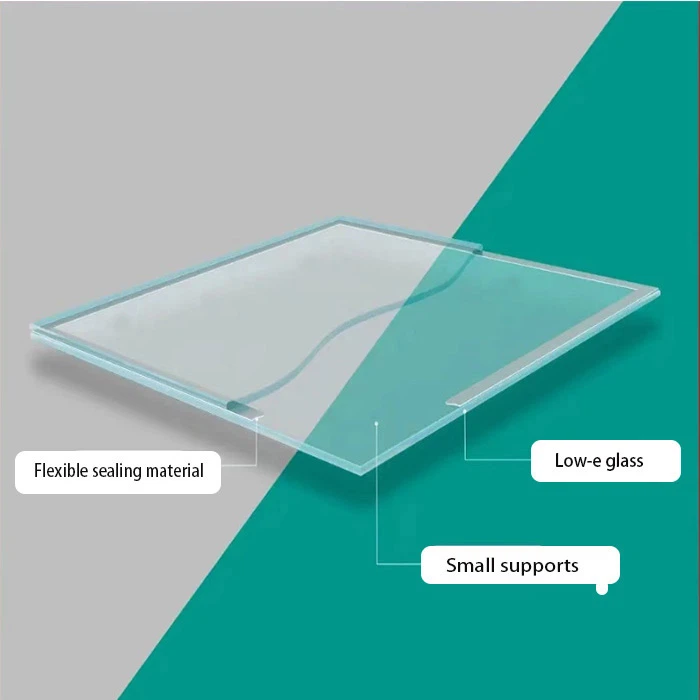
Same as normal insulated glass,the vacuum glass is also made with 2 pieces single piece glass and spacer.The glass can be clear,low iron glass,silk screen glass,low-E coated glass,or even laminated glass.


Key Advantages Of Vacuum Glass
 
01/

Thermal insulation: Vacuum glass provides excellent thermal insulation due to the absence of air molecules between the glass panes. This helps reduce heat transfer, making it an effective solution for energy-efficient buildings.

02/

Sleek design: Vacuum glass can be designed with a thinner profile than traditional double-glazed windows while maintaining similar or superior insulation properties. This sleek design offers more flexibility in architectural applications.

03/

Reduced heat loss: The vacuum minimizes conduction, convection, and radiation between the panels, resulting in less heat loss compared to traditional double or triple glazing.

04/

Improved sound insulation: The vacuum between the glass panes also helps reduce sound transmission, making vacuum glass a potential solution for sound control in urban environments.

05/

Condensation prevention: The absence of air between the panels minimizes the chance of condensation on the inner surfaces of the glass, improving visibility and preventing potential damage.

06/

Enhanced energy efficiency: By reducing the need for heating and cooling, vacuum glass contributes to overall energy efficiency in buildings, aiding in achieving sustainability goals and lowering energy costs.


How Does Vacuum Glazing Work?


It's much the same principle as the Dewar flask or Thermos bottle — a double layer with most of the gas evacuated from the space in between. In the absence of convective heat transfer only radiative transfer can reach the inner 'pane' to heat it, and reflective/low-e coatings on the outer pane deal with most wavelengths that would 'couple' strongly after transmission.


There is still conduction around the edges, so in general material that conducts as little heat as possible is used in seals and structure there.


A principal problem is that the vacuum degrades over time; another is that moisture is preferentially sucked in (where the vapor is effective in heat transfer, and any salts can deposit on the sealed inside as efflorescence). There is also a mechanical problem that limits the pane size and glass thickness, as atmospheric pressure is active on both outer sides. Therefore a common alternative is to pressurize the space with a relatively inert gas (dry nitrogen, for example) which provides reasonable thermal insulation, can be given a reasonable overpressure against moisture intrusion, and is more easily 'purged' and resealed if leakage should occur.


Why We Use Vacuum Glass?
 

Thermal Insulation.
The high vacuum space can decrease the thermal transmission between the 2 side glass.Its thermal performance is 2-4 times that of insulated glass,6-10 times that of single piece glass,which can easily reach the high thermal insulation requirement of passive buildings.


Sound insulation
The vacuum glass sound insulation reach 39mm,which is equal to triple laminated glass,and is higher than any glass products in the market now.


Low condensation point.
Because of the vacuum between glass,the condensation point of vacuum glass is -50℃.


Safety glass
The glass used for vacuum glass is temperature,which belongs to safety glass.The low temperature sealing technology also guarantee the temperature high strength and impact resistance.


Light weight and simple structure
The vacuum space is only 0.3mm,which can be ignored.So vacuum glass can save the storage,logistic fees significantly.
Vacuum glass thickness is only 1/3 and even 1/4 that of insulated glass,the weight is 10kgs/m2 lighter.


Suitable for any area.
As we know the air inside insulated glass will expand if the glass is installed in high altitude areas,while in low altitude areas,insulated glass may shrink which will case visual distortion after glass installed.


Long lifetime.
The expected lifetime of vacuum is 25 years.The special sealing materials ensures high vacuum environment.Compared with normal insulated glass 10-15 years lifetime,vacuum glass lifetime can be 2 times longer.


Types of Vacuum Glass
Single Cavity Vacuum Glass
Vacuum Composite Insulating Glass
2
Vacuum Composite Hollow PVB Glass

Vacuum laminated glass
The product can be made into a single-sided sandwich structure or a double-sided sandwich structure. The thickness of the EVA film (also called EN film) is approximately 0.4 and 0.7mm. The polycarbonate sheet thickness is approximately 1.2mm. Additional glass panels can be selected between 2.5mm and 5mm, and tempered glass can also be used. Another way to make vacuum laminated glass is to pour glue between two layers of glass, and then heat and dry it to make vacuum laminated glass.


"Vacuum + hollow" combined vacuum glass
This structure is equivalent to treating vacuum glass as a piece of glass and then combining it with an additional glass plate to form a hollow. The thickness of the additional glass plate is generally 5 or 6mm tempered glass, which is placed outside the building. It can also be made into a "hollow + vacuum + hollow" structure. Double-sided hollow combination form.


"Vacuum sandwich + hollow" structure
The heat transfer coefficient of this structure is similar to the above-mentioned "vacuum + hollow". However, in addition to the low heat transfer coefficient and improved safety, the advantages of this structure are that the thickness is thinner than that of "hollow + vacuum + hollow", and because both sides of the vacuum glass Asymmetry reduces the resonance of sound propagation and improves sound insulation performance.


Double vacuum layer vacuum glass
The total thermal resistance of this structure can be regarded as the sum of the thermal resistance of two pieces of vacuum glass. If it is a vacuum glass of the same structure, the total thermal resistance is twice that of a single vacuum glass, that is, R double vacuum = 2R.


Essential Tips For Daily Maintenance Of Vacuum Glass


After the installation of vacuum glass is complete, avoid any back-and-forth movement that could cause air leakage at the edges of the vacuum glass.


Be cautious not to subject tempered vacuum glass to sustained pressure. For instance, dining tables and coffee tables in some households have tempered glass tops, which are subject to pressure. The pressure resistance of tempered glass typically ranges from 70 MPa to 100 MPa. The maximum pressure it can withstand is calculated by multiplying the pressure by the area over which the force is applied. The weight of the object that can be safely placed on the glass is calculated as (Pressure × Area) / 10.


Be mindful to avoid contact with alkaline substances such as sodium hydroxide (NaOH) and hydrofluoric acid (HF). Glass is essentially silicon dioxide (SiO2), and it can react chemically with the aforementioned substances.


Be cautious of uneven temperature changes. As mentioned earlier, the internal stress points of tempered vacuum glass are concentrated at the edges. If a piece of glass is subjected to extreme temperatures at both ends, such as high heat on one end and cold on the other, there is a high risk of the glass shattering. For example, pouring cold water on a lit incandescent light bulb can cause the glass to break. Although this scenario is rare for tempered glass, it's better to be safe than sorry.


Avoid striking the vacuum glass with sharp or hard objects forcefully.


Our Factory


The company has a large production base covering an area of about 8,000 square meters. It currently has 50 employees and has complete and advanced glass deep processing production equipment, cutting and grinding steel intelligent connection system, 2 fully automatic glass cutting machines, 2 glass double-sided edge grinding machines, 1 SC-E-SS-2850 horizontal through-type double-chamber double-wind grid forced convection tempered electric furnace; one laminated production line; 2 imported hollow production lines; EVA laminated furnaces and other pre-treatment straight edge machines, special-shaped edge grinding machines, fully automatic cleaning machines and other supporting production equipment, annual production and processing of glass products of about 1 million square meters.


null


FAQ


Q: What is a vacuum glass?

A: Vacuum insulated glass is manufactured by vacuum-sealing two sheets of glass with vacuum sealing material melted at high temperature, while tempered glass generally drops in strength when it is heated at high temperature.

Q: Is vacuum glass worth it?

A: As a superior alternative to traditional insulating glass, vacuum glazing offers a range of benefits that make it a compelling choice for modern buildings. From superior thermal performance and energy efficiency to lighter and thinner construction, vacuum glazing proves to be a cost-effective and sustainable solution.

Q: How long does vacuum glass last?

A: The tested lifespan of vacuum glass is at least 25 years (while maintaining its insulation value). The expected lifespan is 50 years and the warranty on BENGglas® is 15 years. This warranty period is no less than 5 years higher than what is common within the glass industry.

Q: Can you hand vacuum glass?

A: Never vacuum glass with a bagged or bagless vacuum cleaner because the shards will damage the inner workings of both types of vacuums. Shards can puncture the vacuum bag or scratch the inside of your bagless vacuum's canister. The only two options are to use a hose-free handheld vacuum or a shop vac.

Q: What is the history of vacuum glass?

A: History of vacuum glass
Vacuum glass was first described in a 1913 German patent, but it wasn't until the mid-20th century that the technology was actually used. The first commercial product was finally launched in 1996 and was immediately available on the Dutch market from that moment on.

Q: What is vacuum glass made of?

A: A typical VIG unit is produced with two panes of annealed or tempered float glass which is separated by . 05 to 1.7cm steel or ceramic pillars in height. The edge is connected with a solder which creates a vacuum chamber. The seal must contain less 0.1pa pressure in order to keep the stability of vacuum.

Q: How to make a vacuum glass?

A: Seal two glass panes edge with solder glass to form a whole piece; Open a venting hole at an appropriate position for vacuum extraction by using a vacuum pump, ensuring the vacuum pressure between the two glass panes reaching 0.001 mm Hg to make vacuum insulated glass.

Q: Is vacuum glass expensive?

A: Vacuum double glazing is much more expensive than both standard double glazing and triple glazing although it will provide greater value thanks to its u-values and longer expected lifespan. Whilst vacuum double glazing can make a great investment for your glazing needs, the payback time could be prohibitive for most.

Q: What is the R value of vacuum glass?

A: Much like standard air or argon-insulated glass, vacuum-insulated windows can achieve an R-value of 10. This means they are excellent at keeping heat inside your room when the weather is cold and keeping temperatures cool when summer rolls around.

Q: What is the U value of vacuum glass?

A: Vacuum insulating glass is 8.3 mm thick and weighs 20 kg/m²,U value is 0.47W/M2. K. While IGU can only achieve lowest 0.6W/M2.

Q: What is glass vacuum coating?

A: Vacuum coating is a finishing process during which the metal is applied to the surface of the input product by the PVD method. Coating takes place in special vacuum systems and is not only cost-effective but above all very environmentally friendly.

Q: Can you sleep on just a foam topper?

A: We often get asked if it's possible to use a mattress topper as a mattress, and the answer is simple: yes, so long as it's only a temporary solution. There's multiple reasons for this, including an increased risk of back and joint pain, if you skip the mattress and sleep on a bed topper alone.

Q: How is vacuum glass made?

A: Vacuum insulated glass is manufactured by sealing two sheets of glass with sealing materials melted under high temperature. Generally, the strength of tempered glass is increased by heating it at high temperature and quenching it. However, the strength drops when it is heated at high temperature again.

Q: How does vacuum glazing work?

A: Whether air,argon or other gas inside double glass units,the gas contribute to the heat transfer and exchange between inside and outside.
Through changing gas to vacuum, vacuum glazing eliminate the heat convection and prevent heat transfer from external lite to internal glass in summer and in winter prevent inside warm air transferred outside and keep house warm.

Q: What’s the benefit of vacuum glazing?

A: Vacuum glazing can not only decrease the energy consumption,make your summer cool and warm in winter.
Vacuum glazing also brings more benefits,such as make your house more quiet and decrease the noise,especially low and middle frequency traffic noise.Keep your glass free from condensation for up to 25 years.Even though initial investment is huge,the long lasting benefit worse it.

Q: How vacuum insulated glass been sealed?

A: Traditionally sealing materials used in VIG sealing is glass solder,glass are permanently bonded by heating and melting the glass solder,but the high temperature used to melt glass solder will cause glass edge anneal and cause uneven strength of glass panels,and rigid bonding will decrease VIG overall bending strength.

Q: Is vacuum glass flat?

A: Many VIG manufacturers use a cap to cover the evacuation holes after sealing the glass edge,while ,it’s necessary to drill holes on glass and affect glass strength,the cap will also fail after been installed,which has caused bad impression.

Q: Why choose vacuum glazing?

A: The incredible insulation properties of vacuum glazing come with the natural benefits of cheaper heating costs and significantly reduced heat transfer. Vacuum glazing also offers excellent levels of acoustic performance. The sound-proofing capabilities help to reduce outside noise and traffic to a low murmur. This mean sit is often the perfect option for urban centres, where noise pollution offers constant issues. Creating a vacuum between two panes of glass could be up to five times more effective when insulating a house than standard double-glazing technology. Vacuum insulated glazing (or VIG) can equal or exceed triple glazing with less weight and bulk.

Q: How is vacuum glazing constructed?

A: The concept behind vacuum glazing is simple in conception. Standard double glazing has 2 panes of glass separated by a cavity filled with a noble gas, such as argon. The purpose of the denser gas is to make it harder for heat to pass through. Other than using air or other compounds of gas between the panes of glass, vacuum glazing instead employs a thin vacuum that eliminates the capacity for heat loss. In order to prevent further heat exchange, the other elements of the window can also be improved to make them more efficient.

Q: What are the advantages of vacuum glazing?

A: The biggest advantage to vacuum glazing is the incredible thermal efficiency offered by the system. The ultra-thin design of vacuum glazed windows offer performance far beyond standard glazing, with u values that can be as low as 1.0 W/m²K down to 0.5 W/m². This makes vacuum windows the perfect choice to modernise heritage properties, as windows can be replaced without the need for additional structural work being undertaken on the apertures. The vacuum offers no buffer for sound or heat to travel through, making them the most acoustically and thermally efficient options available.

As one of the leading vacuum glass manufacturers and suppliers in China, we warmly welcome you to buy high-grade vacuum glass for sale here from our factory. All glass products are with high quality and competitive price.

Vacuum Composite Insulating Glass, vacuum glass, Single Cavity Vacuum Glass
goTop

(0/10)

clearall