

Hey there! As a pattern glass supplier, I often get asked about the refractive index of pattern glass. So, I thought I'd sit down and write a blog post to clear up any confusion and give you all the lowdown on this topic.
First things first, let's talk about what the refractive index actually is. In simple terms, the refractive index is a measure of how much a material can bend light. When light passes from one medium to another, like from air into glass, it changes direction. The refractive index tells us how much that change in direction is. A higher refractive index means the light bends more.
Now, when it comes to pattern glass, the refractive index can vary depending on a few factors. One of the main factors is the type of glass used. There are different types of glass, such as soda - lime glass, borosilicate glass, and lead glass, each with its own typical refractive index range.
Soda - lime glass is the most common type of glass used in pattern glass production. It has a refractive index typically around 1.51 - 1.52. This type of glass is relatively inexpensive to produce and has good optical properties for most applications. It's what you'll find in a lot of everyday pattern glass products, like Transparent Patterned Glass. These transparent patterned glasses are great for adding a bit of style while still allowing some light to pass through.
Borosilicate glass, on the other hand, has a refractive index in the range of about 1.47 - 1.49. It's known for its high thermal resistance, which makes it suitable for applications where the glass might be exposed to high temperatures. However, it's a bit more expensive to produce than soda - lime glass. You might not see it as often in standard pattern glass products, but it could be used in specialized pattern glass for certain industrial or high - end decorative applications.
Lead glass has a higher refractive index, usually around 1.58 - 1.66. The addition of lead to the glass composition increases its refractive index and gives it a more brilliant appearance. This type of glass is often used in high - end decorative pattern glass, like Decorative Patterned Glass. The higher refractive index makes the glass sparkle more when light hits it, creating a more eye - catching effect.
Another factor that can affect the refractive index of pattern glass is the pattern itself. The pattern on the glass can cause local variations in the refractive index. When light passes through the patterned areas, it interacts with the irregularities in the glass surface. This can lead to some interesting optical effects, like light scattering and diffraction.
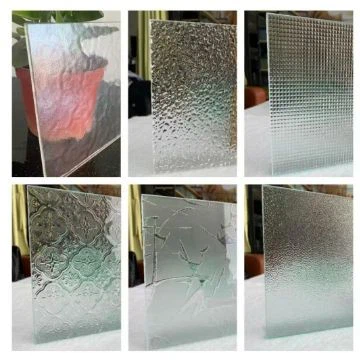

For example, if you have a pattern glass with a very fine, regular pattern, the light might diffract in a way that creates a rainbow - like effect. On the other hand, a more random or coarse pattern can cause the light to scatter in different directions, giving the glass a more frosted or opaque appearance. These optical effects are in addition to the overall refractive index of the base glass material.
Let's also talk about how the refractive index impacts the performance of pattern glass in different applications. In architectural applications, the refractive index can affect how much light is transmitted through the glass and how it's distributed inside a building. A glass with a higher refractive index might bend the light more, which could be useful for directing light in a specific way. For instance, in a room where you want to maximize natural light in a particular area, you could choose a pattern glass with a suitable refractive index and pattern design.
In interior design, the refractive index and the resulting optical effects play a big role in creating the desired aesthetic. Patterned Glass Door Panels can add privacy while still allowing some light to filter through. The pattern and the refractive index work together to create a soft, diffused light that can make a space feel more inviting and cozy.
Now, if you're in the market for pattern glass, it's important to understand the refractive index and how it relates to your specific needs. If you're looking for a glass that will let in a lot of light with minimal distortion, a soda - lime glass with a relatively low refractive index might be a good choice. But if you want a glass with a more decorative, sparkling effect, a lead glass with a higher refractive index could be the way to go.
As a pattern glass supplier, I'm here to help you make the right choice. Whether you're an architect, an interior designer, or a homeowner looking to spruce up your space, I can provide you with detailed information about the different types of pattern glass, their refractive indices, and how they'll perform in your project.
If you're interested in learning more or want to start a conversation about purchasing pattern glass for your next project, don't hesitate to reach out. I'm always happy to chat and help you find the perfect glass solution for your needs.
References:
- "The Physics of Glass" by Mark A. A. Neilson
- "Glass Science and Technology" edited by David R. Uhlmann and Norman J. Kreidl
